
AlterNation's Bloodbirth – by Olchar E. Lindsann
AlterNation's Bloodbirth – by Olchar E. Lindsann
Couldn't load pickup availability
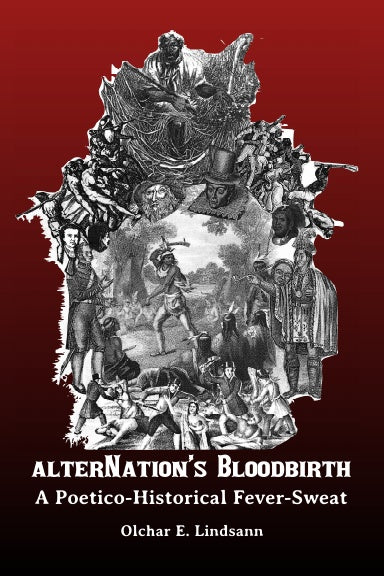
These poems and collages dream fitfully of mythopoeic histories, echoing from the deep woods, exhaled in coal smoke breaths –– seeking the marvellous spectres, avatars, and nightmares that haunt America’s disastrous dreams of reason. They do not tell the story of America’s history; rather, they trace the fractured, hallucinatory images and vanishings of what it has repressed in the service of its unitary self-image, the phantasmagoric other of the positivist Empire’s memory of these terrors and liberties already disappearing as it jolts awake from its sleep, drenched in the authoritarian’s night-sweat.
This is an attempt to evoke the Marvelous (in the surrealists’ sense) that is immanent within history, by means of the magickal operation of poetry: this magick is sought partly in the surrealist swim in the unconscious, following currents beyond the shores of the individual subject or present time; then too, it is inspired in no small part by Blake’s prophetic books, those ever-permuting spectres of western civilization’s neuroses, psychoses, and revolutionary aspirations. In the process, mythic figures emerged unbidden from the writing, and creep through many of the poems. Some of these, such as Glooscap, are insistent ghosts and shadows of ancient gods and heroes, all but lost along with the societies whose lives they breathed. Others are more recent: lauded, fawned on, national myths, one foot in triumphal history, one foot in the realm of archetypes and spooks; here, these spooks have been knocked down a few pegs and dressed up as crass vaudeville villains, hamming it up for the crowd as they play out their dastardly farce. Still others, like Planter-Daddy, are amalgamations, psycho-social spectres resurrected from this mess of memory and language, and squeezed onto the stage as so many terror-clowning Ubus, shaking death from their shitr-sticks. Their broad, mocking, doggerel tone and campy names are inspired by the agit-prop satire pamphlets of the 18th & 19th Centuries.
Share